
'The anti-Digital India campaign is a vindictive hatchet job rather than a fact based, rationally sound appraisal; a personal attack rather than issue based criticism; an ideological assault rather than altruistic effort. It must be called out for what it is,' says Vivek Gumaste.
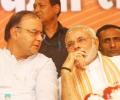
'Amit Shah and Modi have a disciple and guru relationship. But Modi and Jaitley's relationship was based on friendship. That's the difference.'

The vice-president will be the second Indian to be accorded the honour at the Oxford Centre for Islamic Studies. Nikhil Lakshman reports.
If the wave has become a tsunami, why is the BJP's prime ministerial candidate playing safe by polarising voters along communal lines, asks Bharat Bhushan.
As the year 2014 draws to an end, we at Rediff.com take to look at some of the ridiculous remarks made by some blundering politicos.
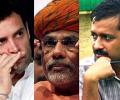
Rahul Gandhi thinks his imaginary Congress is the silver bullet; Narendra Modi thinks he himself is the silver bullet; Arvind Kejriwal seems to think that neighbourhood councils are a silver bullet. But none of them is right, says Mihir S Sharma.

'Unity in diversity is a dated notion as India, today, is more unified and cohesive and yet more pronouncedly diverse than ever in its history,' argues Shekhar Gupta.

'What we are today witnessing is the final act of the Pakistani army trying to retain its turf,' argues Colonel Anil A Athale (retd).

"A Meryl Streep or Jimmy Kimmel can speak their mind, and stay assured that they won't be harmed. That does not happen in India," say Manavi Kapur & Ranjita Ganesan.
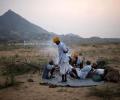
Those who have a long-range mission of true nation-building will pay close attention to World Bank's new action plan for fairness in all matters of land use, says Rajni Bakshi.

'This prime minister thinks he knows everything.' 'He has to consult, he has to talk and he has to mobilise the best people, but having seen him function, I have no expectations from him.'
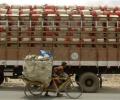
The current draft of the Goods and Services Tax could kill any hope of economic revival - and you should blame the Congress if it rolls over and lets it pass, says Mihir S Sharma.
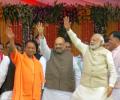
The BJP's manifesto for UP elections promised many things. But, given the state's precarious financial position, fulfilling these promises is likely to prove tricky, says Ishan Bakshi.

'The Post's coverage is not an authentic public discourse guided by unbiased Western intellectuals, but a slanted doomsday propaganda orchestrated by Indians and expatriate Indians,' argues Vivek Gumaste.

'The new generation voter is hyper-nationalistic, but it isn't essentially illiberal.' 'They will find the rants of Adityanath as laughable as Irfan Habib's. They will also find the BJP's polarising approach to vote-gathering unacceptable if it fails to deliver jobs and growth,' says Shekhar Gupta.
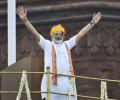
Following is the full text of Prime Minister Narendra Modi's address from the ramparts of the Red Fort on the 73rd Independence Day.

Some of the letters exchanged between the arrested activists spoke of planning 'some big action' which would attract attention, Singh said.

'All of Indira Gandhi's bad economic ideas are being strengthened, from nationalised banks to anti-poverty, handout yojanas,' says Shekhar Gupta.

'A new doctrine now needs to be evolved for a new situation, and the army will do it.' 'You won't see more Kashmiris driven in front of army columns.' 'Nor will the army massacre hundreds, Dyer style,' says Shekhar Gupta.

Our generation got independence too easy, we take our freedom too lightly, we treat our country and environment like toilet paper and take the easy way out because we have no sense of pride or self worth except when it is an India-Pakistan match. We need to be broken more so that we may rise, says film director Suparn Verma.
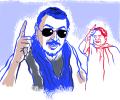
Mayawati has accused 'Ravan' of being a BJP agent who is dividing the scheduled castes.

Is politics gaining at the expense of civil society?
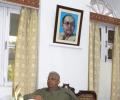
'As a governor, I have every right to speak my mind if I feel the security of my country is at stake.' 'Why is it that we would have to shed tears when Muslims are killed or tortured, but have to keep mum when the Hindus receive the same treatment?'
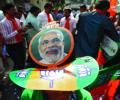
Retired senior US diplomats Teresita and Howard Schaffer believe the 'US cannot afford to continue restricting its contacts with Narendra Modi.' Rediff.com's Aziz Haniffa reports from Washington, DC.


Let Bihar be damned under its contradictions of having gone 'dry' and then having been submerged under flood, which is a recurrent phenomena? After all it is a godforsaken land, having lost its promises of overcoming its problems, says Mohammad Sajjad.
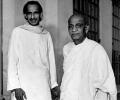
In an era when the misguided youth of today are trying to build political careers by subscribing to divisive ideologies, they need to look to independent thinking icons such as Acharya Kripalani, says Mohammad Sajjad.
On the eve of the release of his book, 2014: The election That Changed India, Rajdeep speaks candidly in an interview with Sheela Bhatt/Rediff.com.

'The Modi-Xi and Modi-Obama meetings, with an interval of just 12 days, are juxtaposed superbly at a crucial point in the prime minister's life. Can Modi carve out a win-win situation with the superpower and the emerging superpower at the same time?'

'The continuing crisis in agriculture, the inability of successive governments to provide secure jobs to millions of youths having varying degrees of skills, and fragmentation of politics have created a sense of despondency.'

'The voter thinks that the State is not going to impartially deliver services, provide justice, basic law and order, social insurance -- so as a voter it's very rational that I may choose a criminal who will help me navigate the State.' 'A weak State allows a criminal politician to be the person who provides that guarantee to mediate whatever problem the citizen has with the State.'

'Power sits lightly on Arun Jaitley's shoulders. Just because earth-shaking election results have brought his party in power, he has not gone recklessly ambitious. "Too soon, too fast" is not what he likes,' says Sheela Bhatt/Rediff.com about Budget 2014.

We take a look at Time magazines top world leaders.

'Modi's campaign has been strikingly devoid of anti-Muslim rhetoric. After the kutta pilla incident, it has been several months since he said something horrible about the Muslims of India. It is the result of democratic constraints. He has to make compromises... He's trying to reinvent himself. He will politically hurt himself if 2002 becomes the definition of Mr Modi again', says political scientist Ashutosh Varshney.

'Nitish is now a helpless junior ally of Hindutva.' 'He just cannot think of reining in the hoodlums raging, marauding and killing in the mohallas,' argues Mohammad Sajjad.

Prime Minister Narendra Modi on Tuesday said Australia will not be at the periphery of India's vision but at the centre of its thought, as he called for closer bilateral security cooperation and a comprehensive global strategy to tackle the menace of terrorism.

Despite being in the crosshairs of the police, politicians and vigilantes, Malini Subramaniam continues to report from a hotbed of Maoist insurgency.
Two former senior United States diplomats, with more than 60 years experience in South Asia between them, have exhorted Washington to establish communication with Bharatiya Janata Party's prime ministerial candidate Narendra Modi sooner than later.
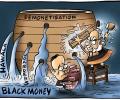
'Modi is likely to make more announcements to win or retain popularity, and put himself at the centre of things even more than now,' says T N Ninan.

'The Kashmiri wants freedom, the dignity that comes from it and the intellectual versatility that flows from the combination of the two,' says political historian Siddiq Wahid.
